1. General Policy Statement
It is a legal requirement that all u3as, as charities, have a safeguarding policy in place to protect their members. “Safeguarding” refers to measures designed to protect the health, wellbeing and human rights of individuals. It includes incidents between members, health related issues, or concerns regarding abuse or neglect that a u3a member may be experiencing outside of the u3a.
This safeguarding policy and procedure applies to all individuals involved in Aughton & Ormskirk u3a.
2. General Arrangements
The Management Committee has a duty of care to its members and is committed to upholding this safeguarding policy in order to protect its members.
We recognise that there are various forms of abuse which can be perpetrated by members, relatives, friends, and neighbours. We will not condone nor tolerate any form of abuse or neglect and believe that all people should be able and, where necessary, enabled to live in an environment which is safe and free from harm.
We will put the well-being of those members at risk of harm first, and they will be actively supported to communicate their views and the outcomes they want to achieve. Those views and wishes will be respected and supported unless there are overriding reasons not to. Any actions taken will respect the rights and dignity of all those involved and be proportionate to the risk of harm.Courses of Action can be found in Appendix 1. Other useful information supplied by Third Age Trust can be found in Appendices 2 – 5.
3. Safeguarding Roles
The Management Committee will:
- appoint a Welfare representative to take the lead on Safeguarding matters;
- ensure members are reminded of the policy (including their roles and who to contact with concerns) periodically;
- follow the safeguarding policy and procedure promptly if they suspect that a member is at risk of abuse. See Appendix 1.
- review the implementation of this policy and procedure annually and update if required.
All Members:
- Safeguarding is everyone’s responsibility and members must raise any safeguarding concerns they have.
- An affected member may also disclose that they are being abused in some way.
- Informing the Management Committee of a safeguarding issue can be done via the Chair, a Group Leader or the Welfare representative.
Group Leaders:
- Group Leaders should contact the Management Committee Chair or Welfare representative if any safeguarding concerns have been brought to their attention.
4. Adoption and Review
This policy was adopted on: 26th August 2025
Last review date: 26th August 2025
Next review date: August 2026
Appendix 1
Courses of Action
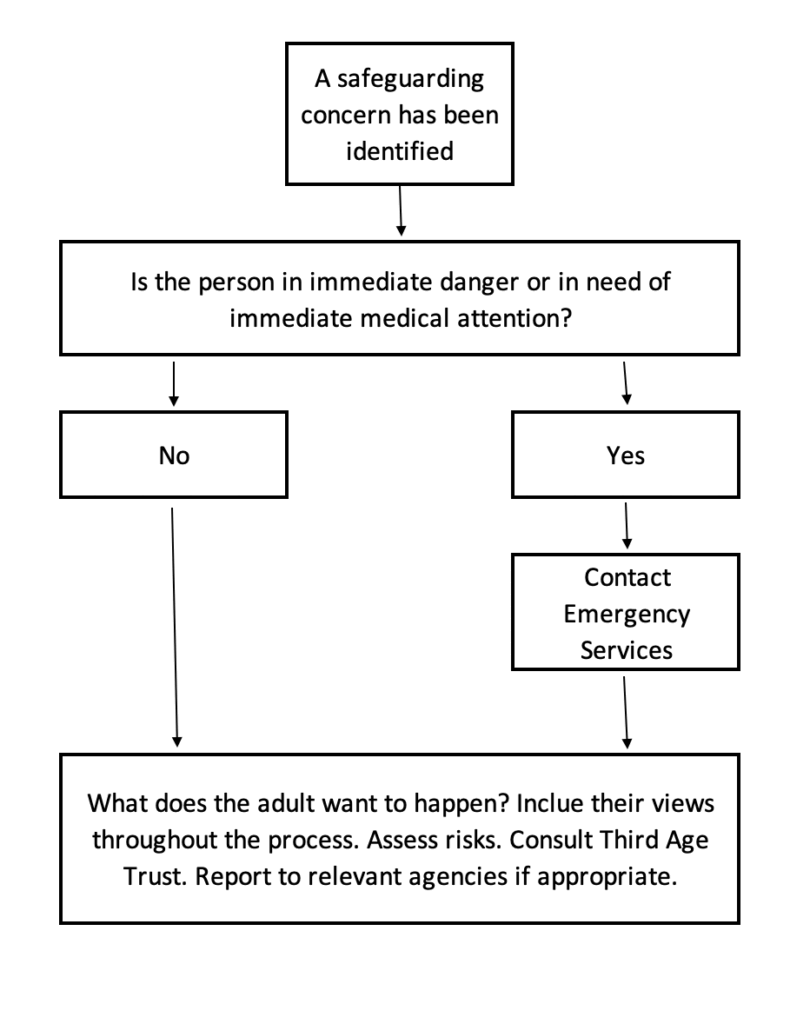
- Where the committee becomes aware of a safeguarding concern, steps will be taken to ensure the safety of adult(s) at risk is secured as a priority. We will endeavour to support all those involved in an allegation.
- The steps to take will be discussed and agreed between the Officers of the Committee in the first instance. No one will act in isolation when dealing with a safeguarding concern. The steps taken should be documented and stored securely in accordance with the Data Protection Act 2018.
- The first step will be to gather as much information as possible to assist with the decision as to the next steps. Risks will be assessed and recorded as soon as possible after the concern comes to the attention of the Committee.
- Where it is deemed that the risk is high and immediate action needs to be taken, the Committee will contact the relevant authorities and the Trust for advice and support.
- In cases of immediate danger you should call 999.
- Third Age Trust can be contacted on 020 8466 6139.
- Lancashire County Council provides the following phone number for adult safeguarding: 0300 123 6721.
- Hourglass (previously Action on Elder Abuse) (wearehourglass.org) is a confidential support and advice for older people who have been abused or people who know an older person who may be suffering abuse. Their helpline number is 0808 808 8141.
- Please note, if a person’s wellbeing or safety is at risk, Under Section 42 of the Care Act 2014, it is not appropriate for A&O u3a to take the lead role in any safeguarding enquiry.
- As far as possible, the adult at risk’s wishes will be respected as to whether or not to refer any concerns to the local authority as a safeguarding enquiry under Section 42 of the Care Act 2014. However, it may be necessary to override their wishes in the best interests of other adults at risk.
- The Committee will consider the level of risk and the action that needs to be taken accordingly. Assessment of risk will include:
- Risk to the individual;
- Risk to other members within the u3a.
- Reputational risk for the individual and the u3a movement as a whole.
- Where the risk is not deemed to be high but support is needed, we will contact the Trust to discuss the concerns and seek additional assistance in developing the risk assessment. Assistance will always be sought before moving to exclude any member from the u3a on the basis of a safeguarding risk assessment.
- Once the risk assessment is completed, the Committee will decide as to the most appropriate course of action. This could include excluding members from certain groups, requesting that a member attends the u3a with a carer or excluding a member from a group run by a particular Group Leader.
- Depending on the nature of the allegation it may be necessary to pursue the incident following our complaints procedure. Where it is decided that this is the best course of action the matter will not be investigated by any party that was privy to the initial reporting of the incident.
- All actions taken will be recorded. We will make every effort to respect the confidentiality of any information that is disclosed under this policy and procedure, however due to the seriousness of allegations confidentiality is not absolute. Information will be recorded and stored securely in accordance with Data Protection Act 2018 but information may have to be shared with relevant authorities on a ‘need-to-know’ basis only, to prevent:
- Danger to a person’s life
- Danger to a person's health
- Danger to others
- Danger to the community
- To facilitate the investigation of a serious crime
Appendix 2
Useful Definitions
Adult at risk
Any person aged 18+ who has need for care and support, is experiencing, or is at risk of abuse or neglect, and as a result of those needs is unable to protect themselves against the abuse or neglect, or risk of it.
Abuse
is the “violation of a person’s human and civil rights by any other person(s). It may be a single or repeated act(s), physical verbal, psychological, sexual, institutional, discriminatory, or financial, an act of neglect or failure to act”.
Types of abuse
- Physical abuse e.g. assault, hitting, slapping, pushing.
- Domestic violence e.g. psychological, physical, sexual, financial, emotional.
- Sexual abuse – including inappropriate looking or touching, indecent exposure and sexual harassment.
- Psychological abuse e.g., threats of harm, humiliation, blaming, controlling, intimidation, coercion, harassment, verbal abuse, cyber bullying, isolation.
- Financial or material abuse e.g., theft, fraud, internet scamming, coercion in an adult’s financial affairs/arrangements, including with wills, property, inheritance or finances, or the misuse/misappropriation of property, possessions or benefits.
- Modern slavery encompasses slavery, human trafficking, forced labour and domestic servitude.
- Discriminatory abuse including harassment, slurs, or similar treatment because of race, gender and gender identity, age, disability, sexual orientation or religion.
- Organisational abuse – including neglect in relation to care provided at home. This may be a one off incident or on-going ill-treatment, through neglect or poor professional practice.
- Neglect and acts of omission – including ignoring medical, emotional or physical care needs, failure to provide access to appropriate health, care and support or educational services, withholding of medication, adequate nutrition and heating.
- Self-neglect - this covers a wide range of behaviour neglecting to care for one’s personal hygiene, health or surroundings and includes behaviour such as hoarding.
Appendix 3
Indicators of Abuse or Neglect
Abuse may be inflicted by anyone that the member comes into contact with. There are many signs and indicators that may suggest abuse or neglect including:
- Unexplained bruises or injuries – or lack of medical attention for an injury
- Non-attendance at interest groups without reason and no response to reminders from group leaders or other members.
- Significant loss or gain of weight and/or an unkempt appearance.
- A change in the behaviour or confidence of a member, where they become quiet and withdrawn, or lash out in anger.
- A member showing fear of a particular group or individual.
- A member who sends unwanted sexually explicit text messages to a vulnerable member
- Threats of physical harm and bullying, or intentional striking of another member.
Additionally, a member may report they are being abused – i.e., a disclosure.
Appendix 4
Underlying Principles
When following the safeguarding procedure, we will strive to uphold the principles that those involved in incidents are entitled to:
- privacy
- be treated with dignity and respect
- lead an independent life and to be enabled to do so
- choose how they live their lives
- the protection of the law
- have their human and civil rights upheld regardless of ethnic origin, gender, sexuality, impairment or disability, age, religious or cultural background.
Additionally, we will follow the principles enshrined within the England and Wales Care Act 2014:
Principle 1 – Empowerment – whereby the approach is focused on the individual making their own decision and gaining informed consent, where possible.
Principle 2 – Prevention – seeking to take steps to prevent issues from arising or escalating.
Principle 3 – Proportionality – responding in a proportionate way to the issue/s being presented.
Principle 4 – Protection – seeking to keep the membership safe and protection for those deemed to be at risk.
Principle 5 – Partnership – reporting incidents to the relevant statutory bodies and liaising with the Trust.Principle 6 – Accountability – accurate recording of incidents. Reporting incidents, as required, to the Trust and to relevant regulatory authorities.
Appendix 5
Tips for Dealing with a Safeguarding Issue
If a member If someone discloses a safeguarding concern to you:
Do:
- Stay calm and try not to show shock or disbelief.
- Listen carefully to what they are saying.
- Be sympathetic (“I’m sorry that this has happened to you”).
- Be aware of the possibility that medical evidence might be needed.
- Tell the person that:
- They did the right thing to tell you.
- You are treating the information seriously. It was not their fault.
- You are going to inform the appropriate person.
- You will take steps to protect and support them.
- Record and report the disclosure in line with your safeguarding policy and procedure.
Do not:
- Press the person for more details if they are not comfortable sharing.
- Stop someone who is freely recalling significant events (Don’t say ‘hold on, we’ll come back to that later’; they may not tell you or anybody else again).
- Promise to keep secrets; you have a duty of care to raise safeguarding concerns.
- Make promises you cannot keep such as “this will never happen to you again”.
- Contact the alleged abuser unless they are also a u3a member and it is necessary to do so to safeguard other members.
- Be judgemental.
- Pass on the information other than to those with a legitimate ‘need-to-know’ under your safeguarding policy and procedure.
When recording a safeguarding concern, members should:
- Note what people actually said, using their own words and phrases.
- Describe the circumstances in which the disclosure came about.
- Note the setting and anyone else who was there at the time of the disclosure.
- Separate factual information from your own and others’ opinions.
- Use pen or biro with black ink so that the report can be photocopied if needed.
- Be aware that your report may be required later as part of a legal action or disciplinary procedure.